

For automated packaging lines for grain, feed, seeds and chemical granules, the bag feed-in device is essential for stronger sealing, preventing leakage and cutting manual labour. Many buyers only focus on price when sourcing a folding infeed machine, overlooking core specifications and line compatibility. Once installed, these poorly selected units often deliver uneven folds, frequent bag jams, fail to match sewing heads and suffer high downtime, dragging down overall line productivity.
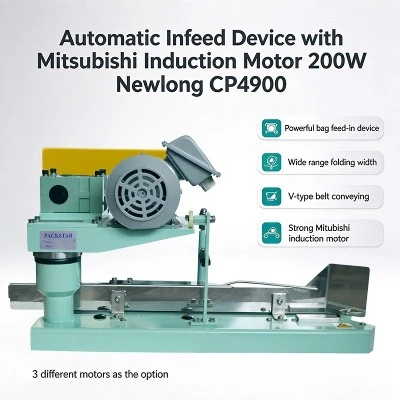
Our PACKSTAR CP4900 automatic bag infeed device is widely compatible with PP/PE woven bags and fabric sacks. It works seamlessly with DS‑9C and GK35 series bag sewing heads and can be mounted on vertical sealing stands or belt conveyors. Drawing on the features of this proven model, we outline the key factors buyers must evaluate before purchasing an automatic bag folding infeed machine.
Motor and Gearbox: Foundation of Long-Term Stability
The motor and gear reducer form the core power system and determine reliability during non-stop mass production.
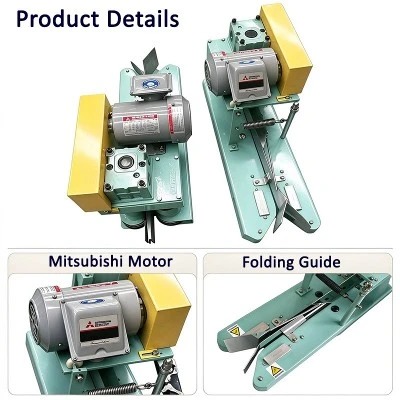
①The CP4900 offers three motor options: Mitsubishi three-phase induction motor, Chinese 3-phase induction motor and speed adjusted motor
②Avoid judging performance by power rating alone:
For heavy-duty continuous operation, choose a branded induction motor with a high-quality reducer to reduce risks of overheating and unexpected stops.If your line requires frequent speed adjustments, confirm the machine supports stepless speed regulation.
Double-check voltage compatibility for your factory power supply. Common options include 220 V / 380 V / 415 V at 50 Hz or 220 V / 440 V at 60 Hz, which is especially critical for export orders.
Process Parameters: Match Folding Width and Speed to Your Bags
Folding width and conveying speed directly control finished sealing quality. The standard CP4900 delivers an adjustable folding width of 35–50 mm and a conveying speed ranging from 7 m/min to 18 m/min. It uses V-belt transport to align and fold bag mouths automatically before feeding sacks into the sewing head, creating tight, consistent seams and minimising material leakage.
Before ordering:
①Ensure the adjustable folding range covers your required finished fold width.
②Confirm the machine's speed band can accommodate your target output. Do not blindly chase top speed; woven and fabric bags tend to wrinkle and drift at excessive conveying speeds.
③Specify bag material. For fertiliser and chemical applications with corrosive environments, select the stainless steel version, CP‑4900‑SS, for extended service life.
Compatibility with Existing Sewing Heads and Production Lines
A common pitfall is a machine that runs well in standalone tests but fails once integrated into an existing line. Bag folding infeed devices are not standalone equipment; they must coordinate with sewing heads, vertical sealing frames and belt conveyors.
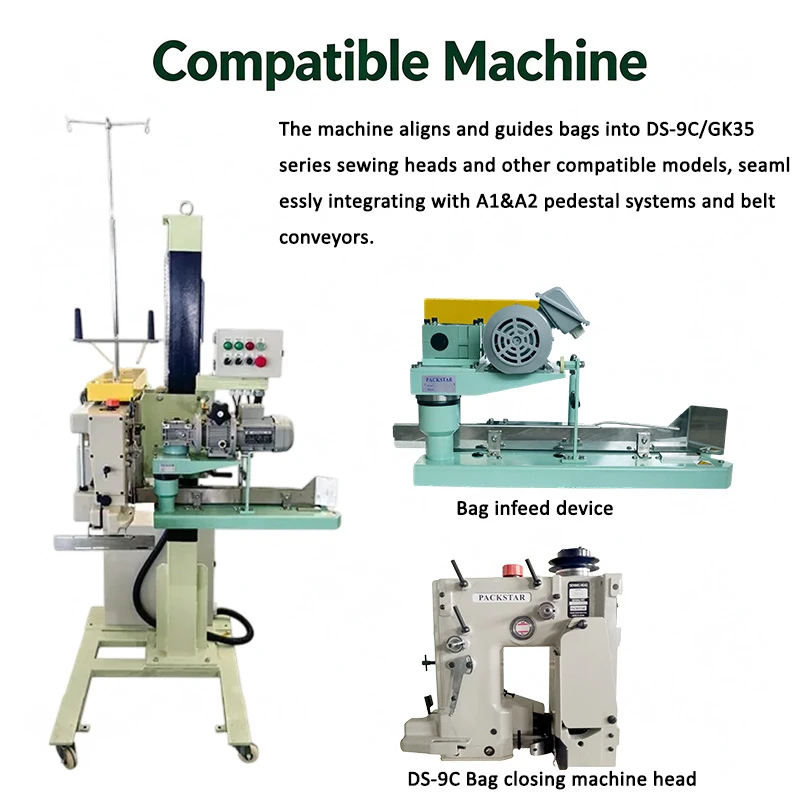
①Share the model of your current bag sewing machine with us to verify direct compatibility. The CP4900 is engineered to fit DS‑9C and GK35 sewing heads and mounts easily on A1 / A2 vertical sealing systems and belt conveyors.
②Confirm the mounting style: vertical stand installation or conveyor integration. Notify the supplier in advance if you require a custom reverse feeding version to suit your line layout.
Mechanical Build, Safety and Customisation Capability
Precision folding guides decide whether folds stay neat. Poorly machined guides lead to crooked folds and inconsistent width, generating large volumes of defective sacks.
①Safety protection: reputable machines come with clear warning labels and guards over all moving components to protect operators.
②Customisation support: special layouts may require reverse feeding, full stainless steel construction or non-standard folding dimensions.
We supports OEM and ODM customisation, including optional reverse infeed assemblies for special line requirements.
Manufacturer Strength, Delivery and After-Sales Support
Industrial bag folding equipment requires ongoing maintenance and spare parts supply long after purchase.
①Check whether we provides pre-sales technical assessment to recommend suitable models based on your bag material, output target and workshop layout.
②Confirm post-delivery services: on-site commissioning, operator training and stable spare parts supply. Reliable spare part availability prevents costly long line shutdowns.
For overseas buyers, confirm the supplier has rich experience handling export projects and can provide power specifications for different countries.
Do not make your purchasing decision based merely on quotations. Evaluate the machine from five dimensions: power configuration, matching process parameters, production line compatibility, material resistance for your working conditions, and the supplier's customisation and after-sales service.
A properly matched automatic folding infeed unit delivers uniform bag folds, improves sealing quality, reduces manual work and cuts waste from leaking sacks, bringing tangible gains for grain, feed, seed and chemical packaging lines.
To contact us:
WhatsApp/WeChat:008613991289750/008618192599526
Email: sales@chinapackstar.com


